PARIS — PRISMA Agentic Research Intelligence System
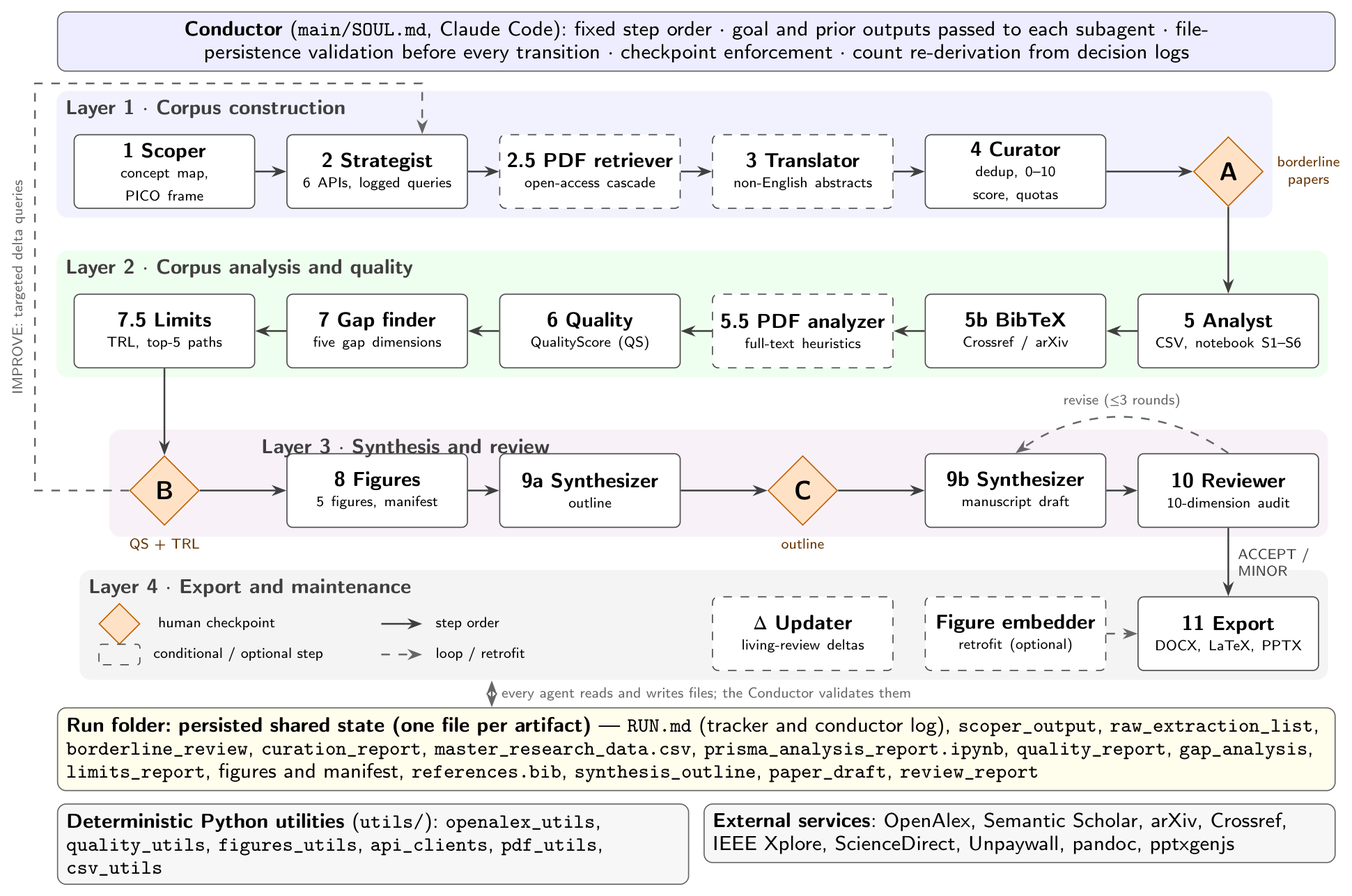
PARIS runs a systematic literature review end to end inside Claude Code. A conductor agent orchestrates 15 specialised LLM agents, from scoping a research question to exporting a manuscript draft. Agents coordinate only through files that the conductor validates, numerical work is left to deterministic Python, and QualityScore grades the corpus before any synthesis is written.
RUN.mdSystematic reviews are the reference method for synthesising evidence, and they are slow: across 195 reviews registered in PROSPERO, the mean time from registration to publication was 67.3 weeks. Most automation tools address a single stage of the workflow. PARIS addresses three problems.
Errors propagate across stages — a record missed at retrieval cannot be recovered at synthesis — yet most systems are designed and evaluated stage by stage.
Screening tools report progress or estimated recall, but nothing tells the reviewer whether the corpus is coherent, balanced and connected to the field's core literature before the synthesis is written.
Asked to reproduce the reference lists of published reviews, GPT-3.5, GPT-4 and Bard hallucinated 28.6–91.4 % of references. A pipeline must expose every intermediate decision and keep humans accountable for the consequential ones.
SOUL.md, under one conductorA fixed workflow at the macro level, agents at the micro level. For each step the conductor forks a subagent with the agent's specification, the research goal and the outputs of earlier steps; it then checks the expected file, records the step in RUN.md, and either proceeds or holds a checkpoint. It never proceeds “on verbal confirmation alone”.
Scoper (concept map, PICO frame) · Strategist (six sources, every query URL logged with counts) · open-access PDF retriever · Translator · Curator (three-key deduplication, 0–10 relevance scores, cluster quotas).
Analyst (master dataset, executed notebook) · BibTeX from Crossref · full-text analyzer · QualityScore · gap finder (five gap dimensions) · limits agent (TRL matrix, top-5 improvement paths).
Figure agent · synthesizer (outline, then a draft whose citations must all be in the dataset) · reviewer (verification checklist, ten scored dimensions, up to three revision rounds).
Word (pandoc + citeproc), LaTeX (elsarticle) and a slide deck · updater for living reviews, which appends delta records and never overwrites.
Records the curator scores 3, or 4 with an ambiguous abstract, go to borderline_review.md. The pipeline stops until the researcher has decided on every one.
The QualityScore dashboard and TRL summary are shown together. Below 65, PARIS recommends improving the corpus; the researcher chooses to proceed or improve.
Clusters, their bridge papers, the section plan, figure placement and how each gap will be covered are approved before a word of the draft is written.
A pre-synthesis index of the structural adequacy of a corpus, computed from artifacts the pipeline already produces. It is decomposable, so a low value points to a corrective action, and transparent: the implementation in utils/quality_utils.py prints every component. It does not measure the recall of the search.
| Sub-score | Weight | Components (saturation) | A low value suggests… |
|---|---|---|---|
| Network Snet | 0.30 | Louvain modularity of the bibliographic-coupling graph (0.7); penalty when fewer than 40 % of papers have OpenAlex reference lists | Fragmented or poorly resolved reference structure: add identifiers, query under-represented communities, check cluster definitions |
| Bibliometric Sbib | 0.25 | Corpus h-index (30); normalised year entropy; 1 − venue Gini; share of papers with > 50 citations (15 %) | Missing seminal work or skewed coverage: backward and forward snowballing, wider date range, more sources |
| Semantic Ssem | 0.20 | 1 − inter-cluster similarity; keyword coverage; 1 − redundancy | Vocabulary drift, near-duplicates or overlapping clusters: revise the keyword map, merge or split clusters |
| Process Sproc | 0.25 | Inclusion-rate band (30–60 %); 1 − source Gini; mean relevance score (8/10) | Imprecise or overly narrow search, single-source dominance: rebalance queries and sources |
Weights and saturation points were set by the authors and have not been calibrated against expert judgments. When citation data are missing, report Snet as missing and give the interval [QS(Snet = 0), QS(Snet = 1)] alongside any point estimate.
Both runs went from a one-sentence goal to exported documents, in two unrelated domains. Human input was limited to the checkpoint decisions. We then audited each complete run folder: query logs, decision logs, dataset, notebook, reports, figures, review and the conductor's log.
| Run 1 · AI chatbots in higher education | Run 2 · AI-assisted SR methods | |
|---|---|---|
| Model, release | Claude Opus 5.5 · PARIS 0.5 | Claude Sonnet 4.6 · PARIS 0.4–0.5 |
| Sources returning records | 3 of 4 attempted (OpenAlex, arXiv, Crossref) | 3 of 5 attempted (OpenAlex, arXiv, Crossref) |
| Records screened → included | 388 → 100 (25.8 %) | 131 → 123 (93.9 %) |
| Thematic clusters | 4 | 10 |
| Open-access full text | 56 / 100 | 29 / 123 (arXiv only) |
| Corpus h-index | 35 (23 before the delta cycle) | 29 |
| QualityScore | 81.9 (A), from 74.6 (B) before checkpoint B | 69.1 (B) recomputed; 73.2 (B) as reported, with a proxy Snet |
| Manuscript | ≈ 9,500 words · 100 cited works · 6 figures | ≈ 8,650 words · 28 cited works · 5 figures |
| Internal reviewer verdict | minor revision (0 critical, 14 minor issues) | accept with minor revisions |
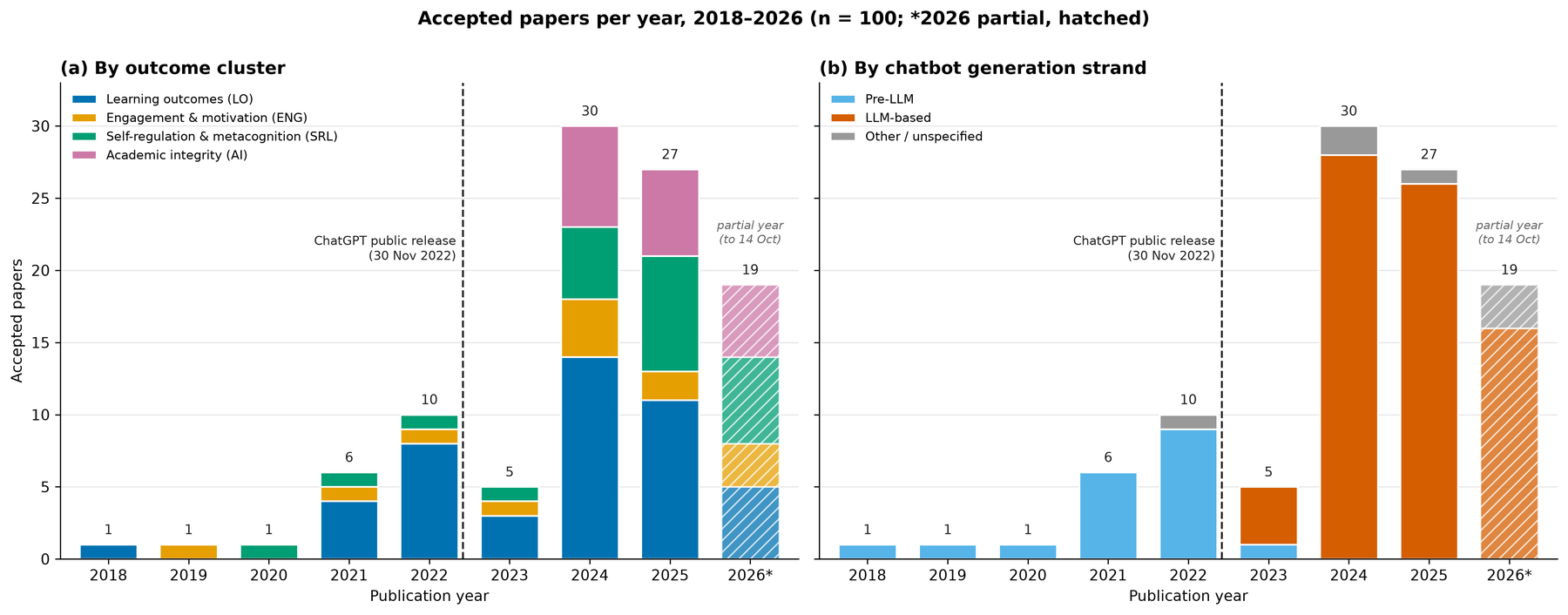
Run 1's first-round corpus held a single study published before 2023. Following the quality report, backward snowballing and a query on 2018–2022 and non-LLM chatbots raised the score from 74.6 to 81.9 and brought 18 more pre-2023 studies, so the review could cover both chatbot generations.
The same Run 1 corpus scores 81.9 (A) with a coupling threshold of 3, 74.0 (B) with 2, and 64.3–64.5 (C) on a co-citation network. Run 2 ranges from 52.6 to 82.6 depending on how missing citation data are handled.
The reviewer agent caught a factual count error in Run 1, but neither Run 1's figure–caption drift nor Run 2's count discrepancies. It is an LLM of the same family as the author agents.
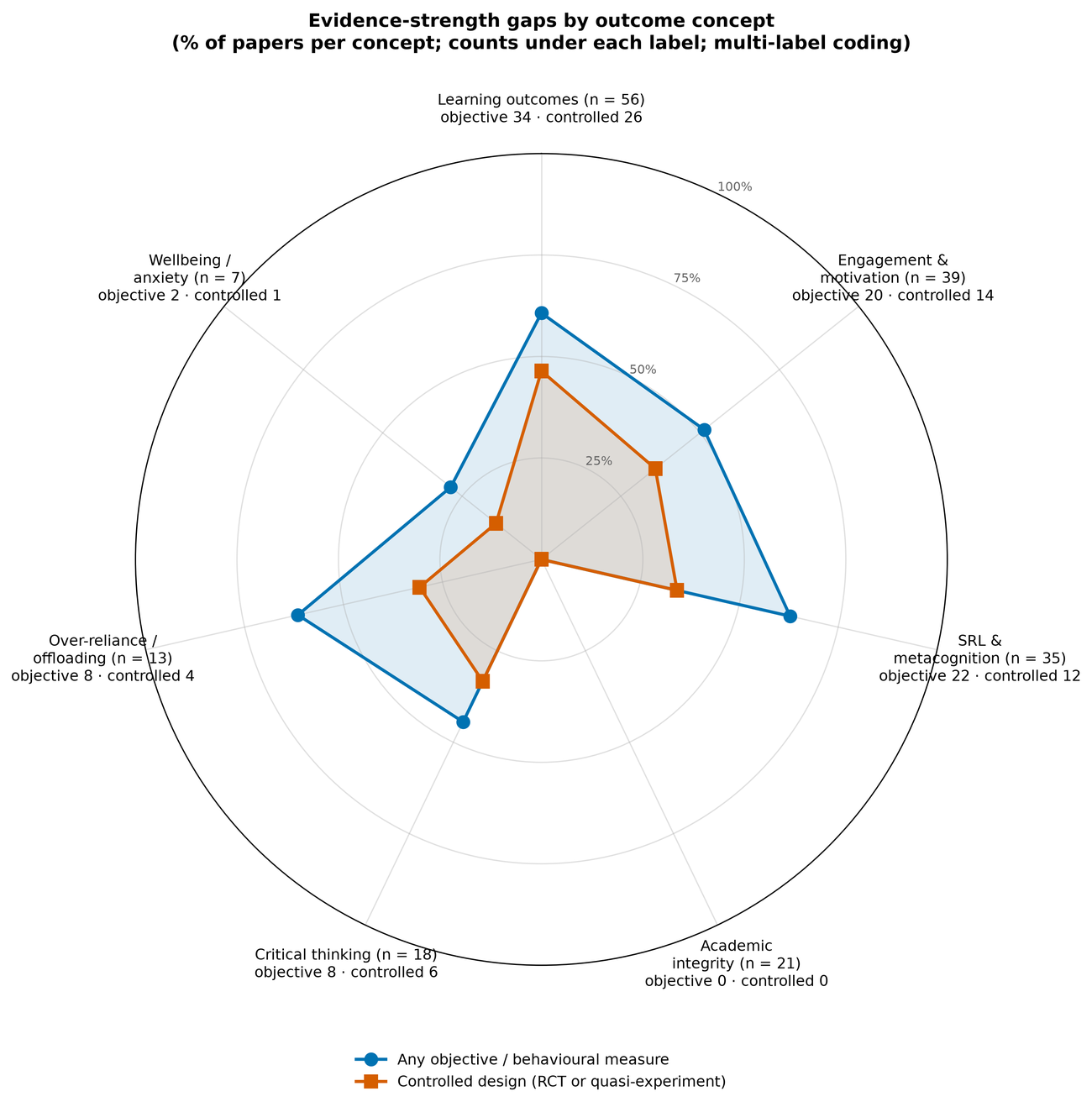
What PARIS found, checked against the run's dataset, gap report and limits report.
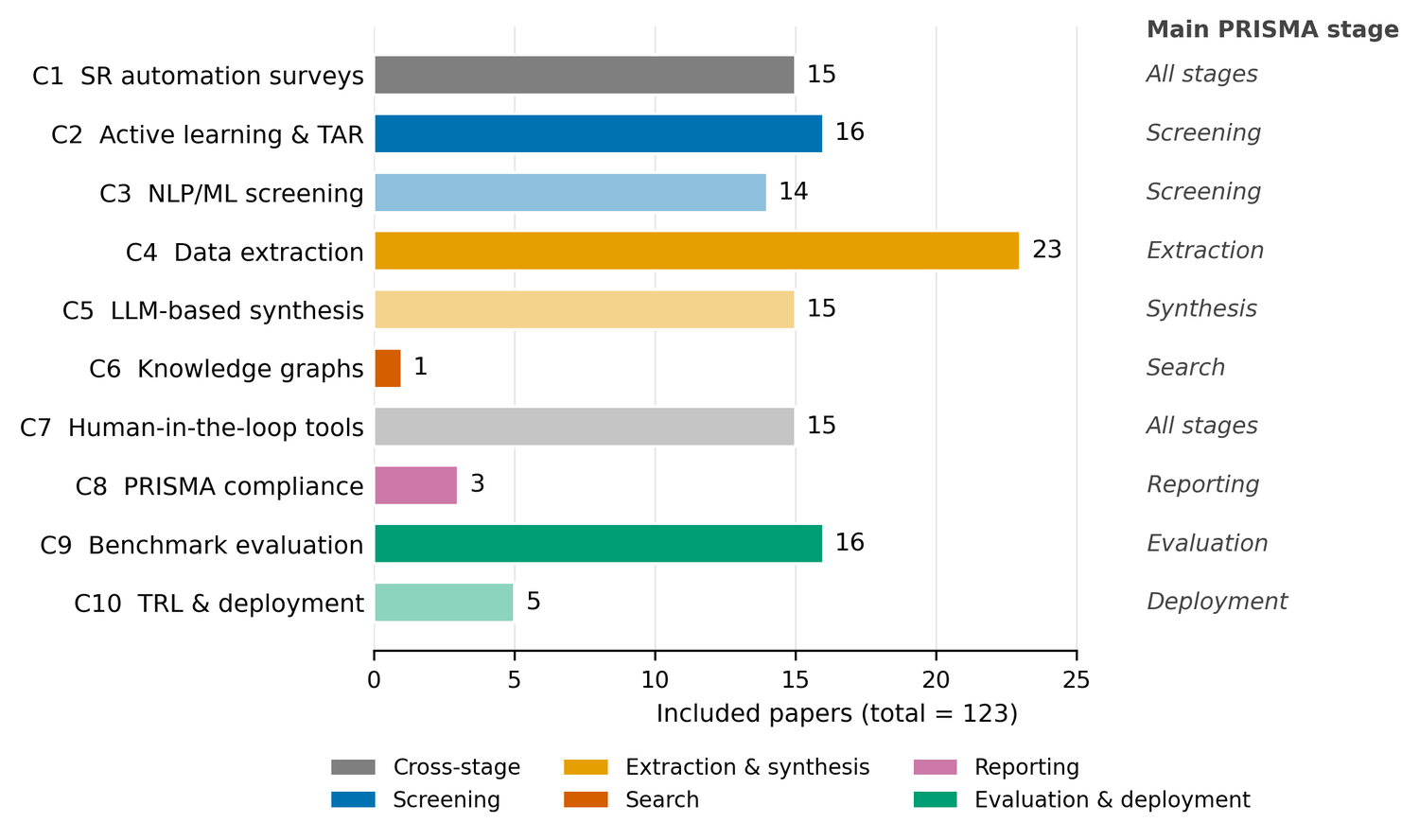
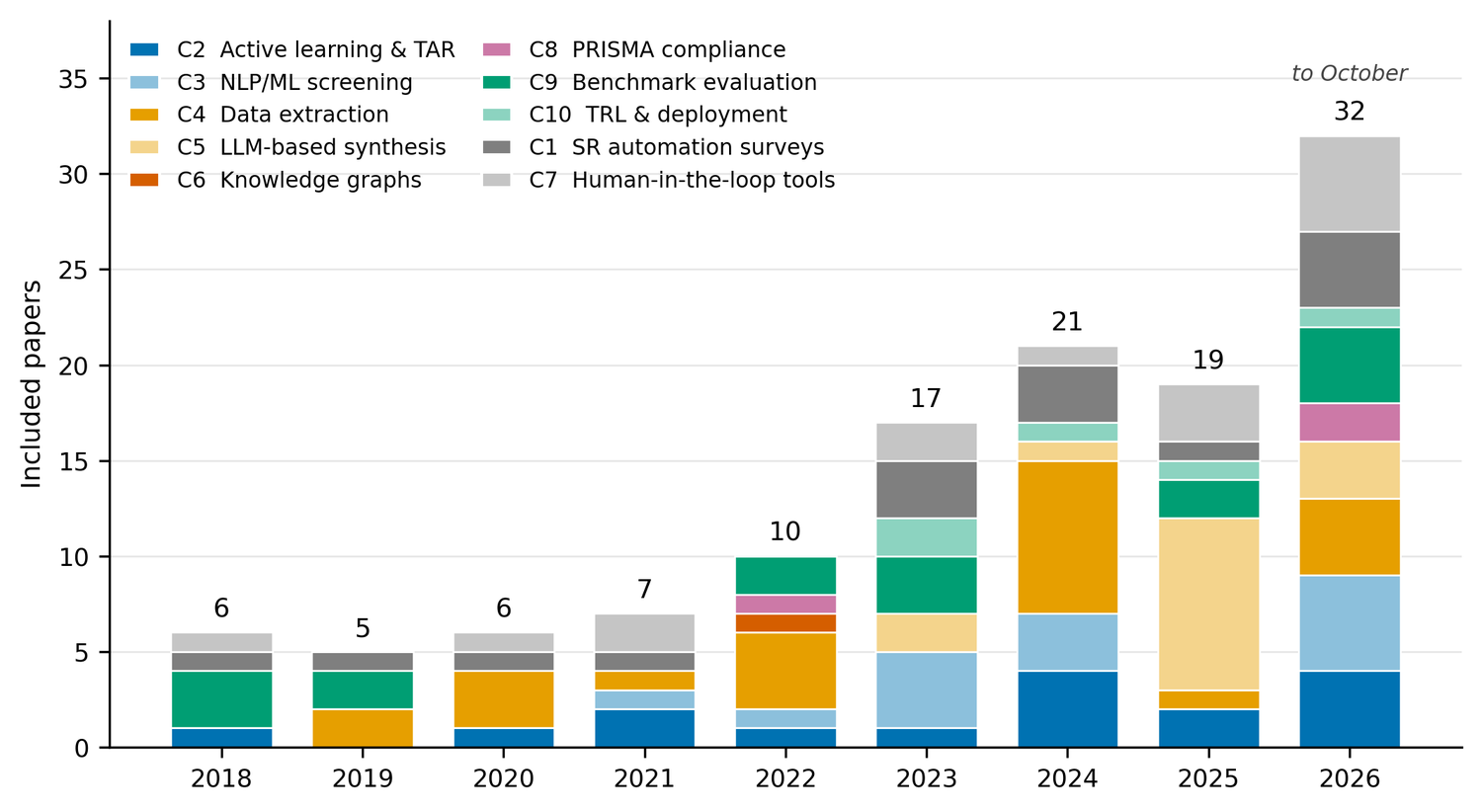
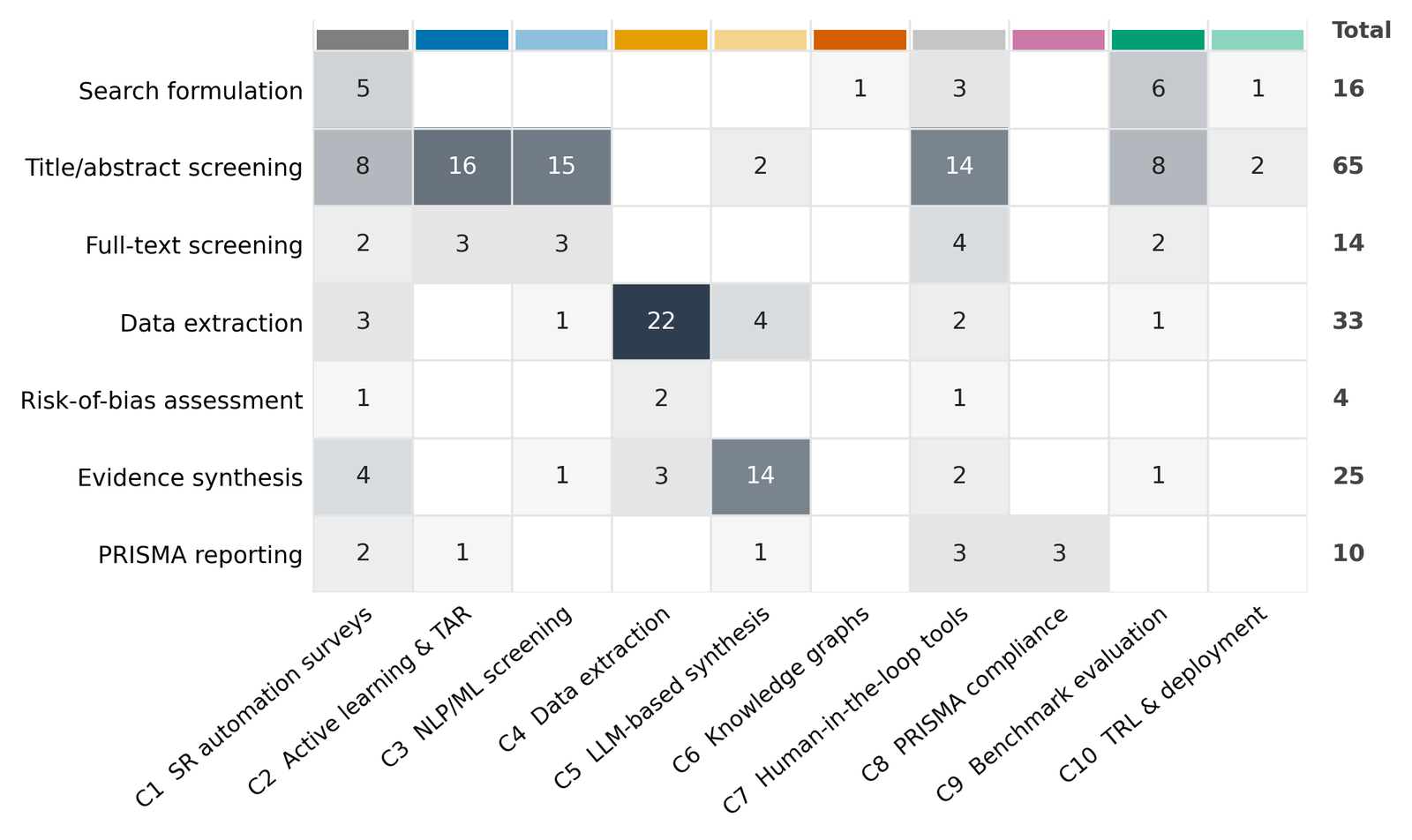
A map of the field PARIS itself belongs to, checked against the run's dataset and reports.
These syntheses are outputs of the case studies, produced by PARIS and checked by the authors against the run artifacts. They have not been validated against human-conducted reviews.
Auditing both run folders exposed 21 failure modes, each documented in the paper with its root cause and mitigation. Only the persisted artifacts made these deviations visible. Three patterns stand out.
In Run 2 the strategist did not paginate and stored snippets instead of abstracts, the analyst produced no notebook, and no checkpoint decision was recorded. In Run 1, checkpoint A was delegated to the conductor, which wrote its own inclusion rule.
The deduplication key order, the contamination guard, count re-derivation and figure embedding were all fixed this way. With counts re-derived from decision logs at every step, no count drifted between Run 1's curation artifacts.
Run 2's artifacts report 114, 117, 125 and 123 accepted papers. None of these discrepancies was caught by the reviewer agent.
PRISMA is a reporting guideline: compliance is a property of a report, not of a tool. We therefore describe PARIS as PRISMA-guided and assess, item by item, which reporting elements its artifacts can support. Support is strongest for the transparency of search and selection, where verbatim query logs and per-record rationales exceed what many manual reviews report, and weakest for appraisal and certainty.
Assessed by the authors from the agent specifications of release 0.6. Because PARIS syntheses are thematic maps of a field rather than effect estimates, its outputs are closer to scoping reviews or systematic maps, for which PRISMA-ScR is the more appropriate reporting guideline.
Review platforms such as Covidence, Rayyan, DistillerSR and EPPI-Reviewer cover more stages than often assumed, and clinical agentic systems offer much stronger validation. PARIS differs in three respects: it targets domain-agnostic scoping and mapping reviews rather than clinical meta-analyses; it gates synthesis on a corpus-level quality index; and its agents coordinate exclusively through persisted artifacts that document every decision.
Scoping, mapping and first drafts in fast-moving fields. Combine it with specialised tools for what it handles least rigorously: screening with principled stopping rules, and risk-of-bias assessment.
Typically scoping reviews or systematic maps, following PRISMA-ScR, unless appraisal modules are added.
Recompute every number in an LLM-written report from the dataset, and check the query log for complete retrieval before trusting the corpus.
PARIS is a set of agent specifications, Claude Code skills and Python utilities. You need Python 3.11+, Claude Code, and pandoc and Node.js for the exports.
# install git clone https://github.com/ChristopheCruz/PARIS.git cd PARIS pip install -r requirements_v03.txt npm install -g pptxgenjs # slide export (pandoc is needed for Word) # optional credentials and polite-pool addresses export OPENALEX_EMAIL="you@institution.edu" export S2_API_KEY="..." # Semantic Scholar export ELSEVIER_API_KEY="..." ELSEVIER_INST_TOKEN="..." IEEE_API_KEY="..." # open Claude Code in the repository and start a review claude /sota-new "your research question"
/sota-new/sota-curate/sota-quality/sota-write/sota-review/sota-export/sota-update/sota-statusRUN.md: tracker and conductor log, with every checkpoint decisionmaster_research_data.csv and an executed PRISMA analysis notebookreferences.bibpaper_draft.md, the review report, and .docx, .tex and .pptx exportsPARIS: A multi-agent LLM framework for end-to-end, PRISMA-guided systematic literature reviews with pre-synthesis corpus quality assessment. Christophe Cruz, Hussam Ghanem, Samir Jabbar, Fatiha Ait Kbir, Hocine Cherifi. Preprint, HAL hal-05852182, 2026.
@unpublished{cruz2026paris,
author = {Cruz, Christophe and Ghanem, Hussam and Jabbar, Samir and Ait Kbir, Fatiha and Cherifi, Hocine},
title = {{PARIS}: A multi-agent {LLM} framework for end-to-end, {PRISMA}-guided systematic
literature reviews with pre-synthesis corpus quality assessment},
year = {2026},
note = {Preprint},
url = {https://hal.science/hal-05852182},
hal_id = {hal-05852182},
hal_version = {v1}
}
To cite the software:
@software{cruz2026parissoftware,
author = {Cruz, Christophe and Ghanem, Hussam and Jabbar, Samir and Ait Kbir, Fatiha},
title = {{PARIS}: {PRISMA} Agentic Research Intelligence System},
version = {0.6},
year = {2026},
license = {MIT},
url = {https://github.com/ChristopheCruz/PARIS}
}
The run artifacts of the two case studies (query logs, decision logs, datasets, notebooks, reports and generated manuscripts) are excluded from the code repository by design and will be made available later.